The parts of this website that help you process a difficult memory are largely an audio guide while your vision and attention is on your calm scene video that is playing on YouTube.
I highly suggest that you figure out the technology portion prior to working on your first memory, so that you are not struggling with the technology while you are activated with a memory.
Here are some options:
If you are on a laptop or desktop computer, you can have YouTube open in one window and have this website opened in another window of your web browser and easily toggle between the two.
If you are listening to this on a smart phone, your YouTube video can be playing on another device (such as a tablet or smart TV… the YouTube app is preinstalled on most smart TVs).
If the only device you have is a smart phone, you can listen on a web browser to the audio guidance and use the YouTube app to access the video.
Make sure you are able to easily Save the YouTube video by looking for the … icon near the bottom right of the video and select “Save” the video to a list that you can access later.
Once you have the four needed skills in place and they work, we can start to move toward working on an individual memory. I’d select one to start with that is not one of the worst things that has ever happened to you. Working on memories in this way is a skill that will be better and easier the more you do it. Save the big ones until after you can successfully process smaller ones.
Before starting any memory, I’d encourage you to check your current level of stress or distress. If you are going into this work already overly stressed, it will be much harder for you to have a positive experience. If you estimate your current level of distress above a 5/10 (before even thinking about the memory), your baseline distress is probably too high. I’d encourage you to do something that gets some of that stress out of your body so you have plenty of emotional “cushion” to manage the distress that may come. Go for a walk, pet an animal, listen to your favorite song, do some deep breathing if that works for you, do the grounding skill I just taught you, or simply watch your selected YouTube video for several minutes until you notice a relaxation response.
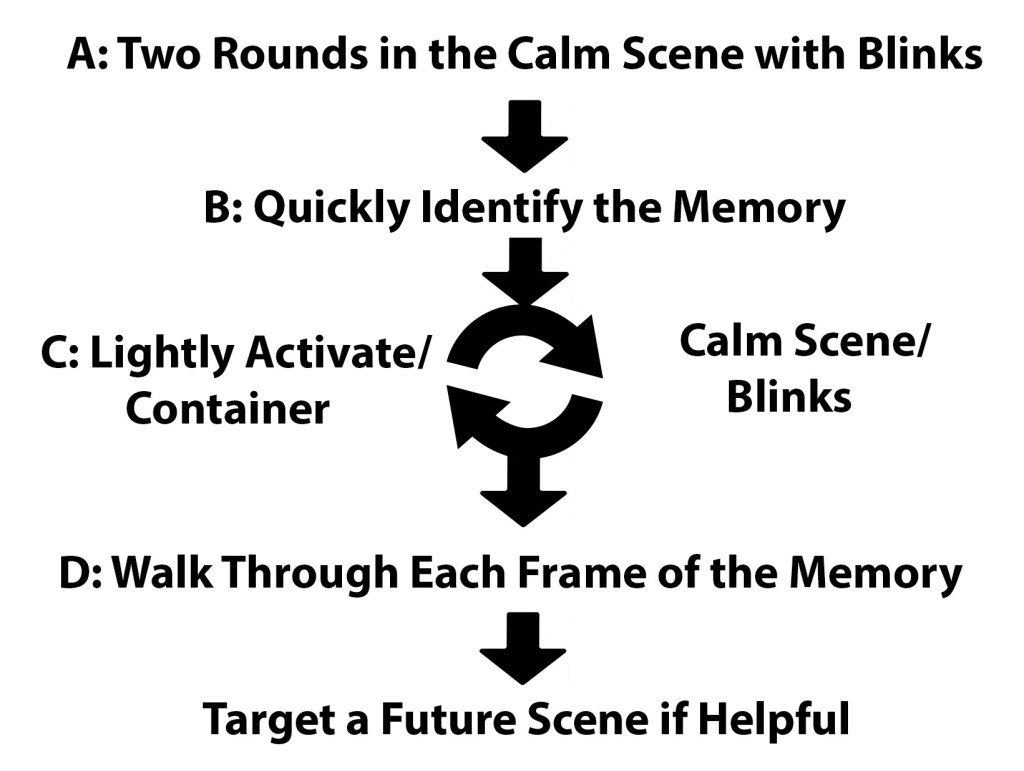
Before selecting the memory to work on, we will spend at least two 30-second rounds in the calm scene. You can play the YouTube video and leave it playing while I guide with audio you through the process. Every five seconds, you will hear me say the word “blink.” When I say “blink,” you will blink your eyes once for about one second, like this. Or, you can blink your eyes twice in one second, like this. If you have eye irritation, you do not have to blink at all. Just look away from the video when you hear me say “blink” for at least a half second and return to the video to have another pleasant experience with it. It is the large number of going into and out of the calm scene that helps process the microslice of the memory that we just put into the container. It is important that you be engaged in that video, because what is shifting the memory is the positive response of your nervous system to the video over and over (I’ll have more to say later about the possible working mechanism).
Once we have done several rounds in the calm scene and you are noticing a positive response, I’ll encourage you to select the memory that you want to work on and immediately push it out of your awareness. Identifying it and pushing it out of awareness are part of the same motion/act. Like an icon on a computer desktop, we only want to click on the memory once to select it. Don’t double-click it and start playing it in detail.
After identifying and pushing the memory away, I will guide you to go into the calm scene with blinks and we will do two rounds there. If anything difficult shows up in the calm scene, we will catch, container, and push that content thousands of miles away. Once it’s gone, we will return to the calm scene with blinks. If you were able to repeatedly find your way back into the calm scene, we will quickly glance at the memory and get a tiny piece of distress. We will container that distress and push it out of awareness. Then, I will direct you to return to your calm scene and will guide you to do more blinks.
We will be in this lightly activate and container / calm scene with blinks loop until you cannot find distress when glancing at the memory.
Then, I’ll guide you to walk through the memory one frame at a time like it’s a piece of videotape. We will catch, container, and push out of awareness each piece of the memory that contains distress, then keep returning to the calm scene with blinks. We do this until you can play the memory from beginning to end and there is no distress in any part of the memory.
I’ll then invite you to do the same thing again with a future scenario instead of a memory to help neutralize future distress. Future targets should focus on things connected to the past memory that are likely to happen. Future targets should not be catastrophic. I’ll guide you to find and container distress when glancing at the future scene, then we will do calm scene with blinks until the distress of the future scene is neutralized using a process very similar to the one we used with the memory.
If you are able to do this and follow this all the way through, the memory should lose its reactivity. You should be able to play it without any distress on any channel. You should believe something more positive about yourself and the world. And, every part of you should know for absolute certain that the memory is over and cannot currently hurt you.
If you have a good experience with this tool, feel free to come back often. However, be careful not to shift too many memories in too short of a span of time. I wouldn’t work on more than several memories in a 24-hour period.
In this approach, we are going out of our way not to activate the memory more than we can catch, container, and push out of awareness. Remember, even baseball catchers wear vests and guards. It is probable at some point when doing this work that you will glance quickly at the memory and the distress will just show up in your body. If you are having distress from the memory in your body, stop. Use this skill that I’m about to show you. It may take a while of using this skill for it to solidify and become strong enough to be helpful.
Have you ever used a ShopVac, a hand-held vacuum, or dropped quarters in a car wash vacuum cleaner? If so, imagine turning on the vacuum and imagine the vacuum pulling air into the hose. Now scan your body and find any points of distress (not from any memory, just your regular right now stress). Search for a knot, pressure, tension, movement, heaviness, or emptiness. If you find it, just imagine moving the hose over that area and imagine that stress just going into the hose like a kind of colored smoke. Not so close that it pulls the skin, just close enough to get some of that distress out of your body. Now the vacuum canister is the container. Push the vacuum canister and hose out of your awareness until they are tiny specks on the horizon. Good.
Were you able to imagine that? If so, the more you use this resource the stronger it is likely to work. If not, try to see if you can scoop distress out of your body with metaphorical hands. Or, see if imagining a bright healing light moving through you helps shift it out of you.
When overactivation does occur and shows up in your body. Try to get it out. When it is out, glance a the memory the next time I guide you to for 1/20th of the time that you looked at it last time, because you probably looked at it too long.
Difficult experiences teach us things. Sometimes they over-teach us things. One of the key differences between really difficult memories and normal memories is that parts of us may not know that the bad experience is over. These experiences may be stored in the part of the brain that can’t know what is over from what isn’t. So when we think about a bad experience, it may feel like it is happening now. We may have the feelings, sensations, and beliefs of the bad experience. One of the things that helps and one of the essential skills that you are likely to need is sensory grounding to let you quickly connect to the safety of the present. Using your senses to ground brings you home. So, anytime you are confused about where your shoes are in this moment, you can do this. Before we start, look around you and see if you can find something that has a pleasant smell. It can be a candle, a perfume, an essential oil, a drink, or even something like Chapstick. Also see if you can find something that has a taste, like maybe a piece of candy or a drink.
We will check the senses for only a few seconds each. You can always experiment with doing this slower or in deeper ways later.
Vision
I invite you to look around your current room and notice several objects. Notice the color(s) of that object. If you were to touch it, would it be hard, soft, or some other texture?
Touch
If there is a piece of furniture near you, touch that piece of furniture and notice if the temperature is warmer, cooler, or the same temperature as your hand. Good.
As you move your fingertips across that surface, notice if the surface is completely smooth or if it has a texture. Good.
As you move your fingertip across that surface, do you notice any changes in temperature? Good.
Sound
I’m going to be very quiet, just notice several things you hear in order of loudest first. Good.
Smell
Now I invite you to smell the object that you selected and you have near you. Good.
Taste
Now taste whatever you have near you to taste. If you don’t have anything, just notice the sense of taste in this moment.
—–
Did that grounding exercise let you feel a little more connected to the current space you are in? If so, good. If not, keep trying it. Also notice which of the senses seemed to be most powerful in connecting you with the present. Those are the senses that we will start with should you need to find the safety of the present.
The active parts of this approach—the parts that are actually helping to move the stuck information—occur in a calm and distracted state. We are processing difficult information while having a right-now experience of pleasant information. The ability and capacity to have a positive experience is important. I’ll provide more information later about the working mechanism underneath this, but for now, let’s just select your calm scene.
The easiest way to do this is to pause here and go to YouTube and find a video that you find relaxing, calming, or funny. Don’t overthink it. It just needs to shift how you feel right now in a pleasant direction. These are some keywords you can search for inside YouTube to give you ideas:
When you watch several moments of that video, does it briefly shift how you feel in a positive direction? If so, find a way to bookmark that video (tips are below). We’re ready to continue. If not, there are over 20 billion videos on YouTube, keep thinking and keep looking.
Alternatives to a YouTube calm scene can be found in the help section.
In this approach, we are going to work one memory at a time. We will glance at that memory very, very, fast. Think about an old-school camera with a shutter that could open and close in 1/128th of a second. That’s the speed that we will start with. We will try to get one one tiny piece of distress at a time out of this memory. Like trying to work one frame at a time in a video. You’re not having thoughts about it or feeling any kind of way about that content. You’re not figuring anything out. Whatever content that emerges will be immediately put into an empty container and pushed far out of awareness. We are also not thinking about the memory as a whole and we are not handling anything other than the microslice that comes out in the very quick glance that we take on the memory. And that little tiny piece that comes out each time we glance at the memory… whatever it is… we are handling like a hot potato and containing it and pushing it out of awareness.
If we are always immediately containing whatever comes out of the memory, we need to develop the container. Yes, this container is usually imaginary. It can be a box, file cabinet, cookie jar, safe, vault, mailbox, rocket ship, or fast-moving train. So, when you hear me say container to hold a tiny piece of something, what comes to mind? Pause here if you need to.
Once you have identified that container, try to see it. Pause and google images of it if you need to. When you settle on the container you want, try to see its color. Try to see what its walls are made of. Pause here if you need to.
Notice how the door opens and closes. Does it make a noise when it opens and closes? Does it have a feeling in your hands as you push the door close and latch it?
Once you have a good idea of how that container works, see if you can open the empty container and see a slip of paper go into it. Something like a post-it note or a random business card. See it go into the container and see the door close. Now, take a step back. Does it feel like what you put in there is in there? If you are not sure open it up in your imagination and see. If you need to, try again.
Now, see the container and push it far, far, away from you. So far that it’s just a tiny speck on the horizon. Were you able to see it get smaller and smaller?
Don’t go forward until you have a container that works because this approach requires that we get distance quickly from the distress that comes out of the memory. For those of you who struggle visualizing, make the container an actual object, like an actual box that you are holding in your actual hands.
Hi. I’m Tom. I want to show you one way that humans can heal from difficult individual memories or experiences. I can almost guarantee you that this approach is different from what you are used to doing. The skills that I will show you before working on any memory are very important. If you skip forward, you are very likely to have difficulties that you wouldn’t have otherwise. This pathway works because of your ability to do these skills I will teach you. You may be able to get through the preparation parts of this site in about 20 minutes. And, once these skills are in place, you can skip this and go directly to the memory work.
About me: I’m Thomas Zimmerman and I’m a mental health therapist in Ohio. However, this is not a therapy site nor is it a substitute for seeing a trauma therapist. To be crystal clear, I’m not your therapist. I’m not selling anything here and I do not benefit financially in any way from you using this site. I’m not looking for nor am I accepting new clients. I’m simply here to show you one way that we can reliably, predictably, and easily heal using pathways that have been inside us for as long as we have been human. Learn how to do this in this way and it is likely to work. Once you see how this healing pathway works, you can make a practice of it to help you better manage past, present, and future stressful experiences.
 Resolve Memories